What is going on at Pawleys Island church?
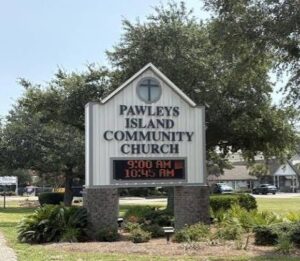
By Sandy . . . What is going on at Pawleys Island Baptist Church and school in South Carolina? For anyone who follows the topics of interest to our community, it would have been impossible to miss the headlines and videos starting the week of July 13, 2026, and intensifying every day for, as of this writing, almost two weeks.
A teacher at the school checked the South Carolina sex offender registry and recognized the church and school custodian as a registered sex offender. Another teacher reported to the Georgetown County Sheriff’s Department that Warren Perry, the registrant in question, was working in a children’s school; the sheriff’s department investigated, verified that Mr. Perry was in violation of his probation conditions, and subsequently arrested him on July 14. Whether his status was that of volunteer or of employee is unclear.
Mr. Perry had started volunteering/working at the church and school in

2021, possibly as early as 2020, which was the same year he committed the crime for which he was charged and convicted in 2023. He was convicted of one count of third-degree sexual exploitation of a minor. In South Carolina, this offense translates to possessing or viewing child pornography, now called CSAM—child sexual abuse material. Generally. each count equals one picture or image. In South Carolina law, a minor is defined as anyone under 18 years of age.
Perry was on probation; his conditions specified that he was not allowed to be in the proximity of children, and he knew it. He had probation’s permission to be at the church, but “Triple P”—Parole, Probation, Pardon—did not know about the school—almost without doubt a deliberate deceit on Mr. Perry’s part.
Arguably, what is with a great deal of doubt is that the church’s minister, Pastor Don Williams, his wife Ginny, and former school director Jennifer Howard knew about and colluded with the deception. This is the contention of Sheriff Carter Weaver and Georgetown County solicitor Jimmy Richardson when they arrested them on the 20th, along with Perry, and charged them with a barrage of offenses; it is also the contention of the multiple civil suits brought in the case.
Pastor Williams, his wife, and the school director resigned July 17.
The lawsuits started immediately, with the first, filed on the 17th, being a class action suit asking for 25 million dollars. Three more were filed on the 21st. They claim negligence, collusion, putting children at risk, and at least one claims a child was molested by Perry in 2022. There almost seems to be a domino effect in play.
This is not uncommon when a celebrity or person in a high position is arrested for a sexual crime; new victims come forth daily. When victims are adults, this is understandable. A lone victim could be reluctant to make such a charge against a movie star, a state senator, or even a local popular figure, but once someone else has had the courage to do so, other victims see that they are not alone. This is akin to what created the “me too” movement.
It is difficult however, is it not, to apply this to the molestation of children? If your child was the victim of such an assault, would you wait for others to come forward before you did? If a child was molested at the school in 2022 by Perry, why is this not part of the criminal charges against Perry? Why is it brought up only as the basis of a civil suit?
So what is going on at Pawley Island’s Baptist Church? It is still very much of an active investigation, but several factors are indisputable:
- Perry began volunteering or working around the church and school in 2020 or 2021.
- In 2023 he pled guilty to a sexual crime committed in 2020; he received a sentence of probation and was placed on the sex offender registry.
- The conditions of his probation expressly forbade his being in proximity of children.
- He did not tell his probation officer that the church included a day-school for pre-k and kindergarten age children.
What does this mean for our advocacy community? Whenever a registrant reoffends or violates the terms of probation, especially when it becomes a high-profile case, the risk is increased for negative consequences. Some one in our legal community opines that whatever progress registrants have made in gaining acceptance in in-person faith communities has been, not only wiped out, but set back twenty years due to this one situation.
Additionally, many bad bills have been proposed and quickly passed in the wake of circumstances such as this one. South Carolina advocates need to be prepared for proposed bad legislation related to this specific case come January 2027.

Warren Perry knew better. He should’ve been forthcoming with pastoral staff and his probation officer from the start. Now the entire State of South Carolina, along with other states and the federal government, I’m sure will enact legislation calling for further deprivation of rights to registrants.
The answer is clear: if anyone is on supervised release it’s their duty to know conditions of release and stick to them. It’s the safety net and keeps offender as well as the public safe no matter how much said offender disagrees with the conditions.