
Using the only comprehensive statewide cost figures ever published—those from the Justice Policy Institute’s 2008 analysis of SORNA implementation—we modeled how registry costs would scale with documented growth in registrant populations, using Virginia and Ohio as bookend examples. [21]
Virginia reported an ongoing annual registry cost of about $8.9 million in 2008, when it had roughly 18,000 registrants; scaling that cost to a conservative 2025 registry size of at least 30,000 yields an estimated $14.8–$18.5 million per year today, or roughly $500–$620 per registrant annually.
Ohio, by contrast, operates a more decentralized, sheriff-based model; constructing a conservative 2008 baseline of $1.1–$1.6 million and scaling it to a present-day registry of roughly 40,000 registrants produces an estimated $2.3–$4.2 million annually, or about $60–$105 per registrant. That lower figure, however, captures primarily state-level and IT-related costs and does not include the substantial workload borne by local police and county sheriff’s departments, where much of Ohio’s registration, verification, and enforcement activity occurs.
These two states bracket a plausible national range. Applying the Ohio-style low per-registrant cost to an estimated 875,000 registrants nationwide yields roughly $50–$75 million per year, while applying the Virginia-style centralized model yields roughly $430–$540 million per year. The true nationwide cost of sex offender registry systems almost certainly lies somewhere between these bounds, with most states falling between Ohio’s decentralized model, which hides many local costs, and Virginia’s more centralized, higher-visible-cost approach.
| Ohio vs. Virginia Costs | National extrapolation (illustrative) | ||||||||||||
|---|---|---|---|---|---|---|---|---|---|---|---|---|---|
This wide spread in costs is expected and informative:
The truth almost certainly lies between these two models nationally. |
These figures rely only on registry operation and compliance scaling.
NSOPW and DOJ materials consistently place the U.S. registry at ~850,000–900,000 registrants in recent years. A conservative midpoint would be ~875,000.[gao.gov] Low end national (Ohio-like) Practical interpretation
That range reflects a national estimate which suggests a defensible midpoint cost nationwide of roughly $200–$350 million per year nationwide, without claiming false precision. |
||||||||||||
Alternative Expenditures and Outcomes
If even a portion of the resources devoted to registries and other post-offense system responses were redirected toward prevention and restorative interventions, the likely return would be not only fiscal but social: lower victimization, lower recidivism, better victim satisfaction, and stronger accountability. The figures below do not suggest that any single alternative can replace every current expenditure; rather, they illustrate that prevention and restorative justice often produce stronger returns per dollar than punishment-centered responses alone. [1, 2, 3]
Prevention Costs Less than Consequences
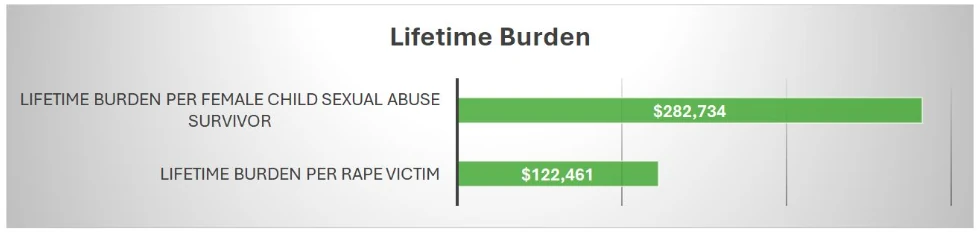
The basic economic case for prevention is straightforward: sexual violence and child sexual abuse create very large downstream costs, while prevention spending is comparatively modest. To keep the comparisons methodologically clean, the figures below separate annual aggregate harm from lifetime per-victim burden. They illustrate the scale of sexual-violence harm, not the composition of registry populations; many people on registries were not convicted of child sexual abuse. Prevention and early intervention programs are often delivered at far lower individual costs, while restorative approaches have been associated with strong benefit-cost ratios, including estimates of roughly $14 in social benefit for every $1 invested. [1, 4, 5, 6, 7]
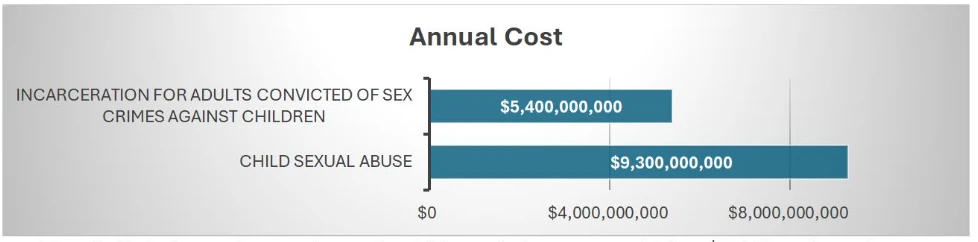
Note: Published annual cost estimates for child sexual abuse range
as high as $80 billion depending on methodology
What Prevention and Restorative Responses Cost
Primary prevention and restorative justice operate at different scales, but both are relatively inexpensive compared with confinement and formal system processing. School-based child abuse prevention programs can be delivered at low per-person or per-classroom cost, while restorative justice programs generally remain far below the cost of probation, incarceration, or prolonged court involvement, even when implemented statewide. [2, 8, 9, 10, 11]
| Program type | Illustrative cost | Comparison point |
|---|---|---|
| Awareness or prevention training | About $8 per person | Low-cost universal prevention |
| Safe Touches-type classroom implementation | About $859 per classroom | Primary prevention at school level |
| Prevention site/county implementation | About $154,243 per site | Local prevention infrastructure |
| Restorative justice case processing | About $1,000 to $4,500 per case | Below typical formal-system and confinement costs |
| School restorative practices | About $57,450 first year | About $139 per student in one estimate |
At the federal and state levels, these strategies are funded through existing channels rather than wholly new bureaucracies. Recent examples include roughly $52.06 million in 2025 awards through the Sexual Assault Services Formula Program, approximately $209.95 million over five years through a recent CDC Rape Prevention and Education cycle, and restorative justice grants and office budgets ranging from hundreds of thousands of dollars to several million dollars at the state level. [12, 13, 14, 15, 16]
Better Outcomes, Not Just Lower Costs
The strongest case for redirecting spending is that the alternatives do more than save money. Restorative justice programs have been associated with much better outcomes than traditional court-centered responses. The chart below highlights three of the clearest measurable gains: lower recidivism, sharply improved restitution completion, and fewer school-based arrests, while reported victim satisfaction rates in restorative programs are often around 90% to 97%. [17, 18, 19, 20]
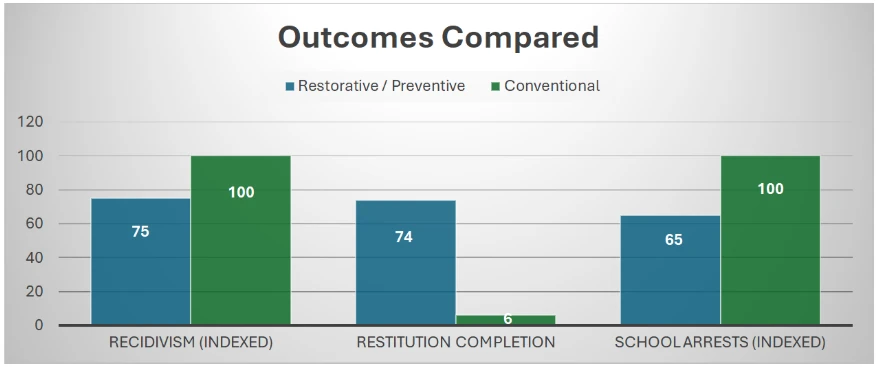
Taken together, these comparisons suggest that the relevant question is not simply what registry systems and incarceration cost, but what the public receives in return from alternative investments. Prevention and restorative interventions do not eliminate the need for accountability, but the available evidence suggests they can deliver more safety, more repair, and greater measurable value per dollar than punishment-centered responses alone. [1, 2, 3, 4, 8, 12, 17, 18, 19, 20]
References